

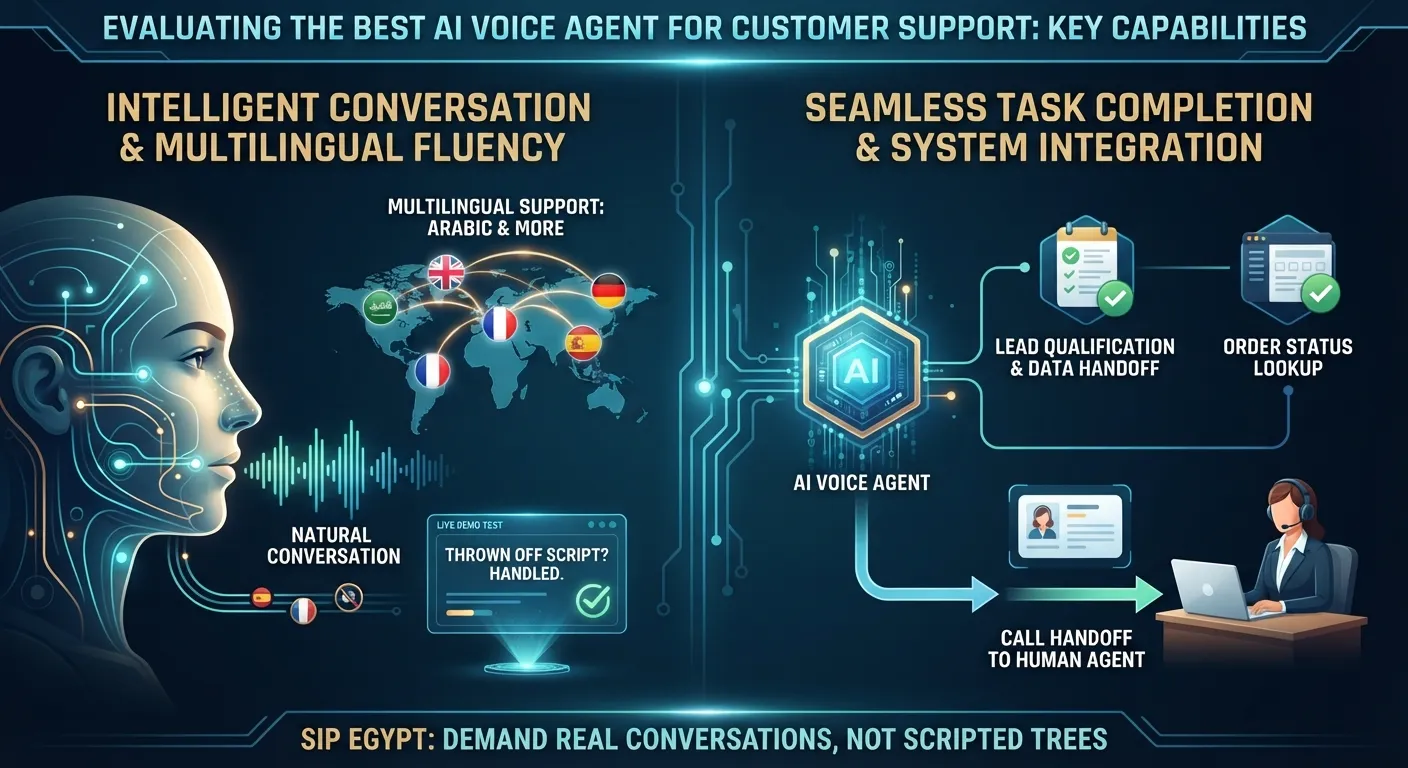
“Best AI voice agent” isn’t a single answer—it depends heavily on what you need it to actually do. However, there are specific capabilities that separate a genuinely useful AI voice agent from one that frustrates customers and gets abandoned within a month. When evaluating modern automated tools, choosing the best AI voice agent for customer support requires looking past flashy marketing decks and analyzing core linguistic, architectural, and integration capabilities. Here is what you need to evaluate before you commit to a solution for your enterprise workflows.
Furthermore, as businesses scale their automated communication systems, implementing the best AI voice agent for customer support ensures operational continuity across digital touchpoints. Modern platforms leverage advanced natural language understanding to streamline inquiry resolution, making the best AI voice agent for customer support an indispensable asset for modern contact centers. Additionally, deploying the best AI voice agent for customer support allows enterprises to maintain 24/7 responsiveness while significantly reducing overhead costs, eliminating long customer hold times, and empowering internal human teams to focus on high-value advisory tasks rather than answering repetitive, transactional questions.
1. Natural Conversation, Not Scripted Trees
The single biggest quality difference between AI voice agents is whether they can handle a real, unscripted conversation—including interruptions, follow-up questions, and requests phrased in unexpected ways—or whether they’re really just a voice-activated decision tree underneath.
Traditional Interactive Voice Response (IVR) systems force callers into rigid numeric paths (“Press 1 for sales, Press 2 for hours”). Modern conversational agents discard this constraint. They parse speech dynamically, allowing callers to speak in natural paragraphs, switch topics mid-sentence, or interrupt the agent when their question has already been answered.
When assessing options for the best AI voice agent for customer support, always ask for a live demo and try to throw it off script. A good agent handles unscripted inputs gracefully, whereas a weak one breaks or enters frustrating conversation loops. Understanding how conversational agents fundamentally change inbound communications requires looking at how they bridge the gap between traditional architectures and modern demands, as detailed in our guide on how AI voice agents are replacing traditional call centers.
Overcoming Rigid Interaction Limits
Legacy voice applications rely on pre-recorded audio prompts mapped to dual-tone multi-frequency (DTMF) button presses. If a customer says something slightly outside the predefined vocabulary or exhibits a regional accent, the IVR system typically responds with an unhelpful error message: “I’m sorry, I didn’t get that. Please try again.” Repeated failures cause immediate customer churn, driving callers to abandon the line or demand an immediate transfer to a manager.
In contrast, an advanced conversational agent utilizes speech-to-text (STT) models, large language models (LLMs) fine-tuned for voice dialogue, and ultra-low-latency text-to-speech (TTS) engines. This stack enables real-time acoustic parsing. The agent understands context, retains short-term conversational memory across multiple turns, and maintains a polite, professional persona even when confronted with aggressive or highly complex customer inquiries.
2. Multilingual Support That’s Actually Fluent
If your customers call in more than one language, check whether the agent handles each language with genuine fluency and natural pronunciation, or whether it’s clearly translating internally and sounds stilted in anything but its primary language.
True multilingual proficiency involves native acoustic modeling and regional dialect comprehension. For businesses operating in the Middle East and North Africa (MENA) region, finding the best AI voice agent for customer support means testing Arabic quality directly—evaluating modern standard Arabic alongside regional dialects—as many legacy AI voice tools are built primarily for English and treat other languages as an afterthought.
When businesses transition away from legacy infrastructure to support localized, multilingual interactions, they frequently realize that older hardware limits performance. Evaluating your broader telecom architecture—such as understanding the difference between a SIP trunk and VoIP—ensures that your underlying network can handle high-concurrency multilingual audio streaming without packet loss or jitter.
The Nuances of MENA Regional Dialects
In markets like Egypt and the broader GCC, customer service interactions heavily rely on local phrasing, idiomatic expressions, and bilingual code-switching (mixing Arabic and English seamlessly within the same sentence). A subpar AI voice solution trained solely on textbook Modern Standard Arabic (MSA) will struggle when a caller uses Egyptian slang or business English terminology.
The best voice agents feature dedicated regional language models that capture acoustic inflections accurately. This ensures that whether a customer dials in from Cairo, Dubai, or Riyadh, the greeting, tone, and pacing feel native, trustworthy, and culturally aligned with the enterprise brand.
3. Real Task Completion, Not Just Q&A
True operational efficiency goes beyond answering basic questions. When selecting the best AI voice agent for customer support, organizations should verify specific transactional functionalities:
-
Can it actually book an appointment and check it against a real calendar, or does it just describe how to book one?
-
Can it qualify a lead and hand structured information to your sales team, or does it just take a message?
-
Can it look up an order status or account detail, or is it limited to answering static FAQ-style questions?
The difference between “answers questions” and “completes tasks” is the difference between a slightly better IVR and a solution that genuinely reduces your team’s workload.
Actionable API Execution vs. Static Retrieval
Many entry-level chat or voice tools operate strictly within a closed loop—they search a knowledge base document and read back a paragraph of text. While useful for checking store hours, this falls short when a customer wants to execute a workflow.
A true enterprise-grade voice agent acts as an autonomous digital worker. Through secure API webhooks, it interfaces directly with backend databases, inventory management software, and scheduling calendars. If a customer calls at 11:00 PM wanting to reschedule a service appointment, the voice agent authenticates the user, accesses available time slots in real time, locks in the preferred slot, sends an instant SMS confirmation, and updates the internal CRM—all without human intervention.
4. Architectural Readiness: Moving Beyond Basic Phone Lines
Deploying advanced conversational intelligence requires more than just scripting what the agent says; it requires a robust operational foundation. Many growing enterprises hit a performance ceiling when they rely on standard analog phone lines or fragmented communication channels that drop calls or lack proper routing queues.
Before scaling up an AI deployment, organizations must evaluate whether their infrastructure is built for multi-channel growth. Upgrading your communication setup is critical for managing higher inquiry volumes without adding headcount. For a deeper dive into operational benchmarks, review our analysis on 5 signs your business needs a cloud call center not just a phone line.
Scalability and Concurrency Demands
Traditional analog phone lines (PSTN) limit a business to a fixed number of simultaneous calls based on physical copper wires. If five customers call at the same time, the sixth caller receives a busy tone. Modern cloud call centers remove these physical constraints entirely through digital trunking and elastic cloud scaling.
When you deploy an AI voice agent, your call volume can spike exponentially during marketing campaigns, seasonal sales, or operational disruptions. Your underlying voice infrastructure must possess carrier-grade concurrency capacity to route thousands of concurrent inbound streams to your AI workflows instantaneously, ensuring zero dropped connections and consistent audio clarity.
5. Clean Handoff to a Human
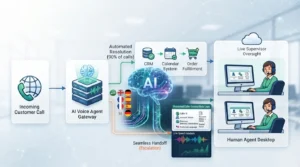
No AI voice agent should try to handle everything on its own. Complex complaints, emotional escalation, or high-value negotiations always require a human touch. What truly matters is how gracefully it recognizes when a call needs a human operator—and whether the handoff includes context (what the caller already said, what they need) so the customer doesn’t have to repeat themselves. A good handoff feels seamless, whereas a bad one feels like starting over from scratch.
Preserving Conversation State During Escalation
Nothing frustrates a customer more than spending five minutes explaining their problem to an automated assistant, only to be transferred to a human agent who greets them with, “Hi there, how can I help you today?” forcing the caller to repeat the entire story.
An enterprise voice agent solves this by compiling a real-time call summary and passing the conversation transcript, customer ID, verified intent, and sentiment score directly to the human agent’s desktop dashboard before the phone connects. When the human picks up, they have full context immediately, allowing for rapid resolution and preserving customer goodwill.
6. Integration With What You Already Use and Securing Your Infrastructure
An isolated AI tool creates administrative silos. Check whether the agent connects to your CRM, your calendar, and your existing phone infrastructure (your SIP trunk or PBX extension) without requiring you to rebuild your technology stack around it. An AI voice agent that cannot plug into your existing telephony setup and data ecosystem creates more operational work than it actually saves.
Furthermore, because modern cloud and AI-driven voice architectures rely heavily on internet telephony protocols, security must be a primary concern. Safeguarding your voice channels against unauthorized access, toll fraud, and interception is non-negotiable for enterprise compliance. To protect your communication pipelines, implement best practices outlined in our guide on SIP trunk security and how to protect your business from VoIP fraud.
Eliminating Tech Stack Friction
Implementing a voice automation layer should integrate smoothly with your existing corporate software ecosystem—whether you manage customer relationships via Salesforce, HubSpot, or custom-built databases. The agent should write call logs, recordings, and lead scoring tags directly into client profiles automatically.
Simultaneously, enterprise security protocols such as TLS/SRTP encryption for voice media streams, IP whitelisting, and multi-factor authentication prevent malicious actors from exploiting VoIP vulnerabilities or hijacking communication trunks. Ensuring robust security safeguards protects sensitive customer data and maintains regulatory compliance across jurisdictions.
7. Reporting You Can Actually Use
You should be able to view comprehensive metrics including call volume, resolution rates, common request types, and exact points where the agent hands off to a human—not just a basic transcript log. That data provides the insights needed to determine whether the system is performing effectively and where adjustments should be made.
Turning Voice Data Into Strategic Insights
Every phone call handled by your AI voice agent represents a wealth of unstructured data. Advanced analytics dashboards aggregate this information to reveal trends that traditional call logs miss.
By analyzing semantic tags across thousands of interactions, management teams can identify recurring customer pain points, track peak calling hours, measure sentiment shifts, and evaluate agent deflection efficiency. These insights allow business leaders to optimize workflows, refine product offerings, and continuously train their AI models to handle edge cases more effectively.
How to Actually Evaluate One
Skip the sales deck and call the system directly. Ask it something outside a typical script, test it in your least-common customer language, and try to get it to book something real. The agents that hold up under that kind of informal stress test are the ones worth a longer trial.
Providers like SIP Egypt exemplify this shift, offering AI voice agents that handle real conversations—not scripted trees—in Arabic, English, French, German, and Spanish, with live handoff to your team when needed. Request a demo and try to throw it off script yourself.