
SIP Trunk vs. VoIP: What’s the Difference and Which Do You Need?
“SIP trunking” and “VoIP” get used interchangeably so often that most people assume they’re two names for the same thing. They’re related, but they’re not the same layer of the system.
If you’re evaluating a new business phone system, moving away from traditional telephone lines, or connecting a PBX to a modern cloud platform, understanding the difference matters. Choosing the wrong terminology can also make it harder to understand what you’re actually buying from a telecom provider.
The simplest explanation is this:
VoIP is the technology. SIP trunking is one specific way businesses use that technology to connect their phone systems to the public telephone network.
That distinction becomes much more important once you start looking at business phone numbers, simultaneous calls, PBXs, call routing, CRM integrations, contact centers, and AI voice agents. When businesses upgrade their infrastructure to handle complex workflows and automation, reviewing our comprehensive guide on 5 signs your business needs a cloud call center not just a phone line helps clarify the operational tipping points that make basic business lines obsolete.
VoIP Is the Broader Category
VoIP stands for Voice over Internet Protocol. It is the general term for transmitting voice calls over an IP network rather than a traditional telephone network.
Whenever voice is converted into digital data and transmitted over an IP network, you’re dealing with VoIP. That can include many different things:
-
A mobile calling application
-
A browser-based calling platform
-
A cloud phone system
-
An IP desk phone
-
A softphone installed on a computer
-
A business PBX operating over an IP network
-
A SIP trunk connecting a business to a telecom provider
This is why saying that a company “uses VoIP” doesn’t tell you very much by itself. Two businesses can both use VoIP while having completely different systems.
One might use a cloud-based phone application where employees simply log in and call each other. Another might operate a 100-agent contact center connected to the public telephone network through multiple SIP trunks. Both are using VoIP technology, but their infrastructure and requirements are very different.
SIP Trunking Is a Specific Kind of VoIP Connection
SIP trunking is a specific business application of VoIP. SIP stands for Session Initiation Protocol, a protocol used to establish, manage, and terminate communication sessions.
A SIP trunk provides the connection between a business phone system—such as a PBX, contact-center platform, or compatible cloud system—and the public telephone network. In simple terms:
-
VoIP describes how voice is transported.
-
SIP trunking describes a specific business connection that uses IP-based voice technology to connect your phone system to the outside telephone network.
This is why a business can have VoIP without necessarily having a SIP trunk. For example, two employees communicating through an internal cloud application are using VoIP, but there may be no SIP trunk involved. Once that business needs its phone system to make and receive calls to ordinary telephone numbers outside the platform, however, it needs some form of telephony connectivity—and SIP trunking can provide that connection.
Think of It Like This
A simple analogy makes the distinction easier. Think of VoIP as the road system—the underlying technology that allows voice traffic to travel over IP networks. A SIP trunk is like a specific highway connection linking your business’s internal phone system to the wider telephone network.
The two aren’t competing technologies. SIP trunking uses VoIP technology. So the relationship is:
This distinction is particularly important when you’re comparing providers. A company saying it offers “VoIP” doesn’t necessarily mean it provides the SIP trunking, DID numbers, concurrent channels, routing, or carrier connectivity your business actually requires. Furthermore, as organizations deploy automated engagement layers, understanding how these transport layers support next-generation automation is essential, as explored in our guide on how AI voice agents are replacing traditional call centers.
How a SIP Trunk Fits Into a Business Phone System
A typical business phone system has several layers. For example:
The employee might be using a physical IP phone, a computer-based softphone, or another compatible device. The PBX handles things such as extensions, call routing, queues, IVR menus, transfers, voicemail, business hours, call recording, and internal calls.
The SIP trunk then provides the external connectivity that allows those calls to reach customers on the public telephone network. Without that external connection, your internal PBX can still manage internal communications, but it doesn’t automatically give your business access to ordinary telephone numbers around the world.
SIP Trunk vs. VoIP: The Key Difference
The easiest way to compare the two is to look at what each term describes:
| Feature | VoIP | SIP Trunking |
| What it is | A broad technology | A specific business telephony service |
| Main purpose | Transmit voice over IP | Connect a phone system to the telephone network |
| Scope | Consumer and business | Primarily business telephony |
| Requires SIP? | Not necessarily | Typically uses SIP |
| Business numbers | Depends on service | Can provide access to business DIDs |
| PBX connectivity | May or may not | Core use case |
| Concurrent calls | Depends on platform | Configured through channels/capacity |
| CRM/Contact center | Depends on platform | Common business use case |
| Public network access | Depends on provider | Core function |
The important thing is that VoIP is not an alternative to SIP trunking. They’re operating at different levels.
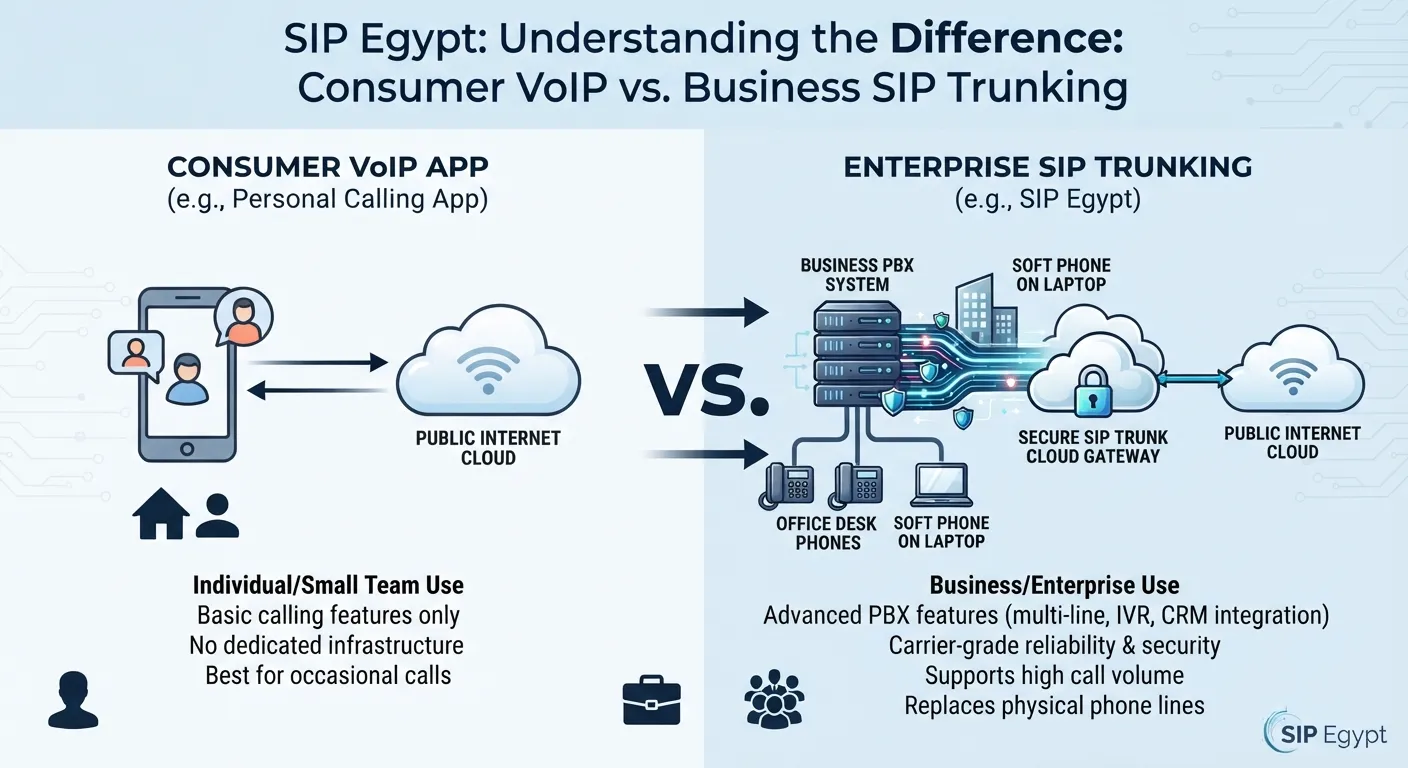
Consumer VoIP Apps vs. SIP Trunking
This is where much of the confusion comes from. Most people have used some form of consumer VoIP. Messaging and calling applications allow users to make voice calls over the internet, often without interacting with traditional telephone infrastructure at all. That’s VoIP.
But a business phone system has different requirements. A company may need:
-
Dedicated business numbers
-
Multiple simultaneous calls
-
Department extensions
-
Call queues
-
Call forwarding
-
Call recording
-
Business-hours routing
-
Caller ID and outbound caller-ID management
-
CRM integration
-
Contact-center software
-
Call analytics
-
AI voice integration
A consumer VoIP application generally isn’t designed to provide that entire infrastructure. SIP trunking, on the other hand, is specifically designed to connect business telephony systems with carrier networks. That’s why comparing a consumer calling app directly with a SIP trunk can be misleading. They’re solving different problems.
What About Cloud Phone Systems?
Cloud phone systems add another layer to the discussion. A cloud PBX can provide many of the functions traditionally handled by an on-premise PBX, including extensions, call routing, voicemail, queues, and business numbers.
But the cloud phone system still needs connectivity to the telephone network if customers are going to call ordinary telephone numbers. Depending on the architecture, that connectivity may be provided directly by the cloud provider or through a SIP trunk.
So a business can have:
or it might have:
Both can deliver a business phone service, but the underlying architecture is different. This is another reason why simply asking, “Do we need VoIP?” isn’t specific enough when designing a business communications system.
What Are SIP Channels?
Another important distinction involves channels. A SIP trunk isn’t necessarily limited to one call at a time. Instead, businesses can provision multiple concurrent call channels.
For example, suppose your company has one main business number but regularly receives 20 calls simultaneously. You don’t necessarily need 20 different telephone numbers; you need sufficient concurrent call capacity.
This is one of the advantages of SIP trunking over traditional line-based infrastructure. A business can provision capacity based on its expected call volume and increase it as demand grows. This becomes particularly important for:
-
Contact centers
-
Sales teams
-
Customer-support departments
-
Appointment-based businesses
-
Seasonal businesses
-
Outbound calling operations
SIP Trunking and Business Phone Numbers
SIP trunking can also work with DID numbers, or Direct Inward Dialing numbers. A DID allows customers to reach a particular destination directly without necessarily going through a central operator. A company might have one main company number, a dedicated sales number, a support number, a billing number, a number for a specific branch, or campaign-specific numbers. Those numbers can then be routed through the same broader phone infrastructure.
For businesses operating in Egypt, this makes local number availability an important consideration when comparing SIP providers. If you need Egyptian business numbers, don’t just ask whether a provider offers VoIP. Ask specifically about SIP trunking, DID availability, numbering coverage, concurrent channels, and connectivity to the public telephone network. Furthermore, ensuring that your communication channels are properly encrypted and shielded against unauthorized traffic is vital; review our security guidelines on SIP trunk security and how to protect your business from VoIP fraud to safeguard enterprise assets.
SIP Trunking vs. VoIP for Call Centers
The distinction becomes even clearer in a call-center environment. A call center might have dozens or hundreds of agents using IP phones, softphones, contact-center software, CRM systems, call recording, predictive or automated dialing, and AI voice agents. All of those systems can use VoIP technology.
But the connection that allows the call center to make and receive calls through public telephone numbers is a separate infrastructure consideration. That’s where SIP trunking becomes relevant. A simplified architecture could look like:
The contact-center software controls the agent experience and call workflows. The SIP trunk provides the external telephony connection. VoIP is the underlying IP-based voice technology that allows this communication to happen.
Where AI Voice Agents Fit In
Modern AI voice agents add another interesting layer. An AI voice agent can answer calls, understand spoken requests, qualify leads, schedule appointments, answer questions, and transfer callers to human employees. But the AI itself doesn’t eliminate the need for telephone connectivity. A business still needs a way for customers to reach the AI using an actual telephone number.
SIP infrastructure can provide part of that connection. For example:
If the AI needs to escalate the call:
This is one reason SIP trunking remains relevant even as businesses adopt cloud communication and AI. The interface may become more intelligent, but the underlying telephone connectivity still matters.
Does SIP Trunking Require VoIP?
In the context of modern IP telephony, yes—SIP trunking is fundamentally an IP-based voice service. But the reverse isn’t true: not all VoIP is SIP trunking.
-
A browser-based calling application can use VoIP without providing a SIP trunk.
-
An internal company communication platform can use VoIP without connecting to the public telephone network.
-
A consumer calling application can use VoIP without exposing a traditional business PBX to carrier infrastructure.
So the relationship can be summarized as: SIP trunking is a type of VoIP-based business connectivity, but VoIP encompasses much more than SIP trunking.
Which One Does Your Business Need?
The answer depends on what you’re actually trying to accomplish.
If you’re an individual who simply wants to make internet-based calls through an application, you may only need a VoIP service. If you’re a small business looking for a cloud phone system, you may need a cloud PBX with built-in carrier connectivity. If you already operate a PBX or contact center and need to connect it to external telephone networks, SIP trunking is much more likely to be the relevant service.
A business that needs multiple business numbers, extensions, department-based call routing, concurrent calls, a PBX, contact-center software, CRM integration, call recording, local DIDs, and AI voice integration should be evaluating its business telephony architecture, not simply asking whether it has VoIP.
What Should You Ask a SIP Provider?
If you’re currently comparing providers, don’t stop at “Do you offer VoIP?” Ask more specific questions:
-
Do you provide SIP trunks? This confirms you’re looking at a business-grade telephony connection rather than simply a consumer calling application.
-
Which DIDs are available? If you’re operating in Egypt, ask specifically about the geographic numbers and numbering options you need.
-
How many concurrent calls can we support? This determines whether the service can handle your actual call volume.
-
Is our existing PBX compatible? If you’re already using a PBX, you may not need to replace it.
-
Can the service integrate with our contact center or CRM? This becomes increasingly important as businesses connect telephony with customer data and automation.
-
What happens during an outage? Ask about redundancy, failover, routing, and service availability rather than relying only on a headline uptime figure.
-
How does pricing work? Understand channel charges, number charges, inbound and outbound rates, international calling, setup fees, and any additional services.
When VoIP Alone Is Enough
Not every business needs a traditional SIP trunk. If your entire team works inside a cloud communication platform and that platform already provides telephone numbers, carrier connectivity, routing, and the features you need, adding a separate SIP trunk may not provide much additional value.
The important thing is to identify where your telephone connectivity comes from. You might not personally configure a SIP trunk because your cloud provider manages that layer for you. That doesn’t mean the underlying service isn’t using SIP or carrier-grade VoIP infrastructure; it’s simply abstracted away from the end user.
When SIP Trunking Makes More Sense
SIP trunking becomes particularly relevant when a business wants more control over its telephone infrastructure. That can include businesses that:
-
Already have a PBX
-
Want to keep existing phone hardware
-
Need multiple DIDs
-
Operate a contact center
-
Need significant concurrent call capacity
-
Have multiple locations
-
Want to connect telephony with CRM software
-
Are deploying AI voice agents
-
Want to migrate away from traditional physical lines
In these cases, SIP trunking can act as the bridge between the company’s internal communication system and the wider telephone network.
The Short Version
The simplest way to remember the difference is:
-
VoIP is the technology.
-
SIP is a protocol commonly used for IP communications.
-
SIP trunking is a business telephony service that uses SIP to connect your phone system to the public telephone network.
So if someone says, “We’re switching from traditional phone lines to VoIP,” that may be technically correct, but it doesn’t tell you exactly what architecture they’re deploying. If they’re connecting an existing PBX to a telecom provider through IP-based channels, they’re likely talking about SIP trunking.
The distinction matters because choosing a business phone system isn’t simply about finding a way to make calls over the internet. You also need to consider numbers, channels, routing, PBX compatibility, reliability, integrations, and how the system will support your business as it grows.
SIP Egypt provides carrier-grade SIP trunking with Cairo and nationwide DID numbers, designed for business phone systems, contact centers, cloud platforms, and modern voice applications. If you’re unsure whether your current setup is a consumer VoIP service, a cloud phone system, or a true SIP-based business architecture, the right place to start is by mapping how your calls currently enter, leave, and move through your organization.