
A few years ago, calling a business customer support line usually meant enduring a frustrating, rigid experience: an automated Interactive Voice Response (IVR) tree droning instructions like “Press 1 for sales, press 2 for technical support, press 3 for billing, or stay on the line to hold.” More often than not, callers found themselves trapped in recursive loops, unable to reach the right department without pressing zero repeatedly or hanging up in complete exasperation.
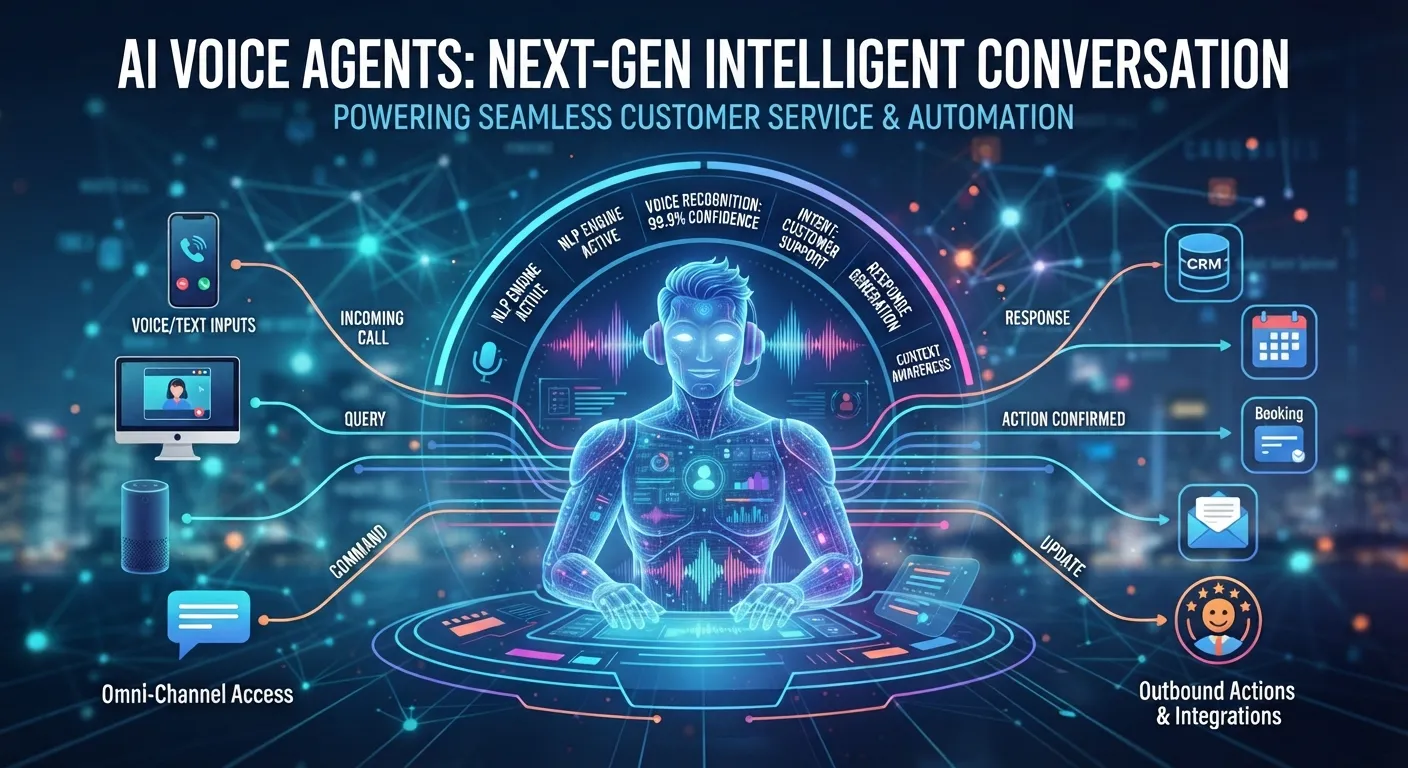
Today, conversational AI has completely shifted that paradigm. AI voice agents represent a generational leap in telephony technology. Instead of forcing human customers through rigid, predefined keypad menus, modern voice agents utilize advanced natural language processing, real-time speech recognition, and large language models (LLMs) to hold fluid, intelligent, human-like conversations over the phone. They can understand intent, handle unexpected interruptions, negotiate scheduling conflicts, query enterprise databases, and execute multi-step business transactions entirely on their own.
As voice AI becomes increasingly sophisticated, affordable, and accessible, organizations across industries are deploying it to manage everything from inbound customer service queues and lead qualification to appointment booking, outbound notification campaigns, and multilingual support. However, deploying voice automation is not about replacing human employees entirely. Rather, the highest value of AI voice agents lies in automating repetitive, high-volume interactions so human staff can focus on complex problem-solving, emotional empathy, and high-value negotiations.
This comprehensive guide explores what AI voice agents are, how they operate under the hood, how they differ from legacy technologies, what tasks they can automate, how they integrate with your broader telephony stack, and why they are rapidly becoming an indispensable asset for modern call centers.
1. What Is an AI Voice Agent?
An AI voice agent is an advanced software system designed to answer or place telephone calls while holding a natural, spoken conversation with the person on the other end.
Unlike legacy IVR systems that rely strictly on dual-tone multi-frequency (DTMF) keypresses or brittle speech-recognition commands (where callers must say exact keywords like “Billing” or “Support”), an AI voice agent interprets natural human language in all its varied forms. If a customer dials into a service provider and says, “Hey, I need to check if my technician appointment next Tuesday can be moved from the morning to an afternoon slot because my schedule changed,” the agent parses the intent, queries the scheduling database, negotiates a new time, and confirms the adjustment on the fly.
Core Characteristics of AI Voice Agents
-
Intent Recognition: Rather than hunting for rigid keywords, the system comprehends context, sentiment, phrasing variations, and indirect statements.
-
Dynamic Responses: Instead of playing rigid pre-recorded audio files, the agent generates contextualized, conversational answers tailored specifically to the caller’s unique situation.
-
Task Execution: The agent interacts directly with backend enterprise software (such as CRMs, ERPs, and calendar systems) to complete live workflows during the call.
2. How AI Voice Agents Actually Work
Behind the conversational interface, an AI voice agent integrates several distinct technologies operating simultaneously in real time to ensure responses feel immediate and natural:
-
Automatic Speech Recognition (ASR): Captures the caller’s spoken audio stream and instantly converts it into clean, machine-readable text.
-
Natural Language Understanding (NLU) & LLMs: Processes the transcribed text to extract user intent, sentiment, and required entities (such as dates, account numbers, email addresses, or product SKUs).
-
Dialogue Management & Integration Layer: Determines the next conversational turn, enforces business rules, and communicates via APIs with external databases, customer relationship management tools, or booking calendars.
-
Text-to-Speech (TTS) Synthesis: Converts the generated text response back into natural-sounding human speech complete with appropriate inflection, pacing, and emotional tone.
To maintain a natural conversational cadence, modern voice architectures focus intensely on minimizing latency, handling sudden interruptions gracefully, and executing seamless turn-taking. Businesses supply operational context—such as pricing sheets, FAQs, inventory statuses, and escalation rules—ensuring the agent operates strictly within corporate guidelines.
To explore how voice automation transforms these interactions from the ground up, review our comprehensive guide on AI voice agents explained: how they’re replacing traditional call centers.
3. AI Voice Agents vs. Traditional IVR Systems
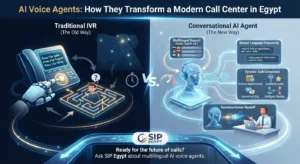
The difference becomes clearer when you compare the two approaches. Traditional IVRs are generally menu-driven. The business determines the possible paths in advance, and callers navigate those paths using keypad selections or specific spoken commands.
AI voice agents are conversation-driven. The caller can explain what they need in ordinary language, and the AI determines the appropriate path. That doesn’t mean traditional IVRs are useless. They can still be effective for simple routing and predictable workflows. However, they become frustrating when a customer’s situation doesn’t fit neatly into one of the available menu options.
AI voice agents are particularly useful when businesses receive calls where the customer’s intent varies considerably from one conversation to another.
| Feature | Traditional IVR | AI Voice Agent |
|---|---|---|
| Interaction Model | Rigid menus (keypad / fixed spoken commands) | Conversational (natural, open-ended language) |
| Call Flow | Linear, predefined paths | Dynamic, intent-driven routing |
| Adaptability | Breaks when requests fall outside menu options | Comprehends varied phrasing and conversational context |
| Primary Utility | Basic call routing and simple status checks | Complex inquiries, data collection, and task execution |
| Customer Frustration | High (frequent dead ends and loops) | Low (resolves inquiries quickly in plain language) |
4. What Tasks Can AI Voice Agents Handle?
AI voice agents can handle a wide range of repetitive, well-defined interactions:
Answering Customer Questions
Businesses can use AI agents to answer common questions about hours, services, pricing, availability, locations, policies, and other frequently requested information. This means customers don’t necessarily have to wait for a human agent just to get an answer that could be provided immediately.
Qualifying Leads
An AI voice agent can speak with inbound leads, ask predefined qualification questions, collect contact information, understand what the prospect is looking for, and pass qualified leads to a sales representative. Instead of having sales staff spend their time collecting basic information, they can receive a structured lead that is ready for the next stage of the sales process.
Booking and Confirming Appointments
Appointment scheduling is another natural use case. An AI agent can ask what type of appointment the caller needs, identify available times, book the appointment through an integrated system, and provide confirmation details. Depending on the workflow, it can also make reminder calls or send an SMS confirmation.
Intelligent Call Routing
Rather than asking every caller to choose between a long list of departments, an AI agent can determine the reason for the call through conversation. A billing question can go to billing. A technical issue can go to support. A sales inquiry can go to the appropriate sales team. The result is a routing process based on intent rather than menu selection.
First-Line Customer Support
AI voice agents can handle common support requests where the solution is well-defined. When the issue falls outside the agent’s capabilities, it can escalate the conversation to a human. This human handoff is important. A good AI system shouldn’t try to answer every possible question simply because it can generate a response.
5. Inbound vs. Outbound AI Voice Agents
AI voice technology isn’t limited to incoming calls.
-
Inbound AI agents answer customers who contact the business. They’re commonly used for customer support, appointment scheduling, FAQs, lead qualification, and call routing.
-
Outbound AI agents initiate calls. Depending on the business and applicable regulations, they can be used for activities such as appointment reminders, lead follow-ups, customer notifications, surveys, confirmations, and other structured communication.
The key difference is the workflow. Inbound systems need to be prepared for a broad range of customer intentions, while outbound systems usually begin with a more clearly defined objective.
6. AI Voice Agents vs. Human Agents: Where Each Wins
Deploying voice AI does not mean replacing human teams. Instead, high-performing organizations leverage a hybrid operational model:
-
Where AI Wins: Speed, 24/7 availability, consistent adherence to scripts, multi-call concurrency, and tireless execution of repetitive administrative tasks.
-
Where Humans Win: High-empathy situations, complex conflict resolution, high-value sales negotiations, and ambiguous scenarios requiring emotional intelligence and nuanced judgment.
When an AI agent detects frustration, complex technical demands, or explicit requests for a human representative, it initiates an intelligent human handoff, transferring the call along with complete conversation transcripts and CRM context so the customer never has to repeat themselves.
7. How AI Voice Agents Integrate With Business Systems
An isolated phone bot offers limited value. Modern AI voice agents act as conversational interfaces directly connected to your enterprise software stack:
For example, when a client calls to reschedule a delivery, the agent authenticates the user against the CRM, queries the logistics database for open delivery slots, updates the shipping record, and reads back the confirmation number—all within a single continuous exchange.
8. Why Multilingual Voice AI Matters in Egypt
Language is particularly important in markets such as Egypt, where businesses may interact with customers in Arabic and English while also serving international customers. Traditional call-center operations may require separate language teams or carefully managed staffing schedules.
A multilingual AI voice agent can provide a different approach. A single system can be configured to communicate in Arabic, English, French, German, and Spanish, allowing businesses to support customers across multiple languages without creating an entirely separate automated workflow for every language.
This can be particularly useful for companies operating in tourism, hospitality, healthcare, telecommunications, financial services, e-commerce, and other industries where customer demographics can vary significantly. The quality of the experience still depends on proper configuration, language support, pronunciation, terminology, and testing. Simply translating a script isn’t enough to create a genuinely natural multilingual conversation.
9. Where AI Voice Agents Can Make the Biggest Difference
AI voice agents are particularly suited to industries where businesses receive a large number of repetitive calls:
-
Healthcare: Appointment scheduling, reminders, basic information, and routing.
-
Hospitality: Reservations, availability questions, booking assistance, and guest inquiries.
-
Real estate: Lead qualification, property inquiries, and appointment scheduling.
-
E-commerce: Order information, delivery questions, and basic customer support.
-
Telecommunications: Account questions, service information, and first-line support.
-
Professional services: Lead intake, appointment booking, and frequently asked questions.
The exact use case varies, but the common factor is usually the same: a significant volume of calls following relatively predictable workflows. If you are evaluating when your organization needs to move beyond basic telephony lines to support these workloads, read our analysis on 5 signs your business needs a cloud call center not just a phone line.
10. Security, Privacy, and Reliability Considerations
Because voice interactions frequently involve Personally Identifiable Information (PII) and financial data, secure deployment is mandatory. Organizations implementing voice AI must ensure:
-
Data Encryption: Secure transmission and storage of call logs and customer records.
-
Regulatory Compliance: Adherence to local data protection laws (such as Egypt’s Personal Data Protection Law [PDPL]) and explicit call-recording disclosures.
-
Failover Architecture: Robust fallback mechanisms that reroute callers to human agents if backend integrations or APIs experience downtime.
To ensure your underlying voice infrastructure remains protected against malicious exploits and toll fraud, review our implementation checklist on SIP trunk security and how to protect your business from VoIP fraud.
11. Related Insights & Implementation Guides
To dive deeper into modern business communications and cloud infrastructure, explore our additional resources:
-
Learn how to evaluate your infrastructure with 5 signs your business needs a cloud call center not just a phone line.
-
Understand the underlying transport layer by reading our breakdown on SIP trunking vs. VoIP: What’s the difference and why it matters.
-
Protect your communication channels using our recommendations in SIP trunk security and how to protect your business from VoIP fraud.
-
Explore industry transformation trends in our detailed feature on AI voice agents explained: how they’re replacing traditional call centers.
12. Getting Started With AI Voice Agents in Egypt
For organizations in Egypt seeking to modernize customer operations, SIP Egypt provides carrier-grade SIP trunking paired with advanced, multilingual AI voice agents capable of handling inbound and outbound communications in Arabic, English, and European languages. Furthermore, to make sure your underlying connection layer is fully optimized for enterprise workloads, check out our technical breakdown on SIP trunking vs. VoIP: What’s the difference and why it matters.
If you are ready to transition your phone infrastructure beyond basic IVR menus, reach out to schedule a live demo and hear how conversational AI integrates into your existing telephony stack.