

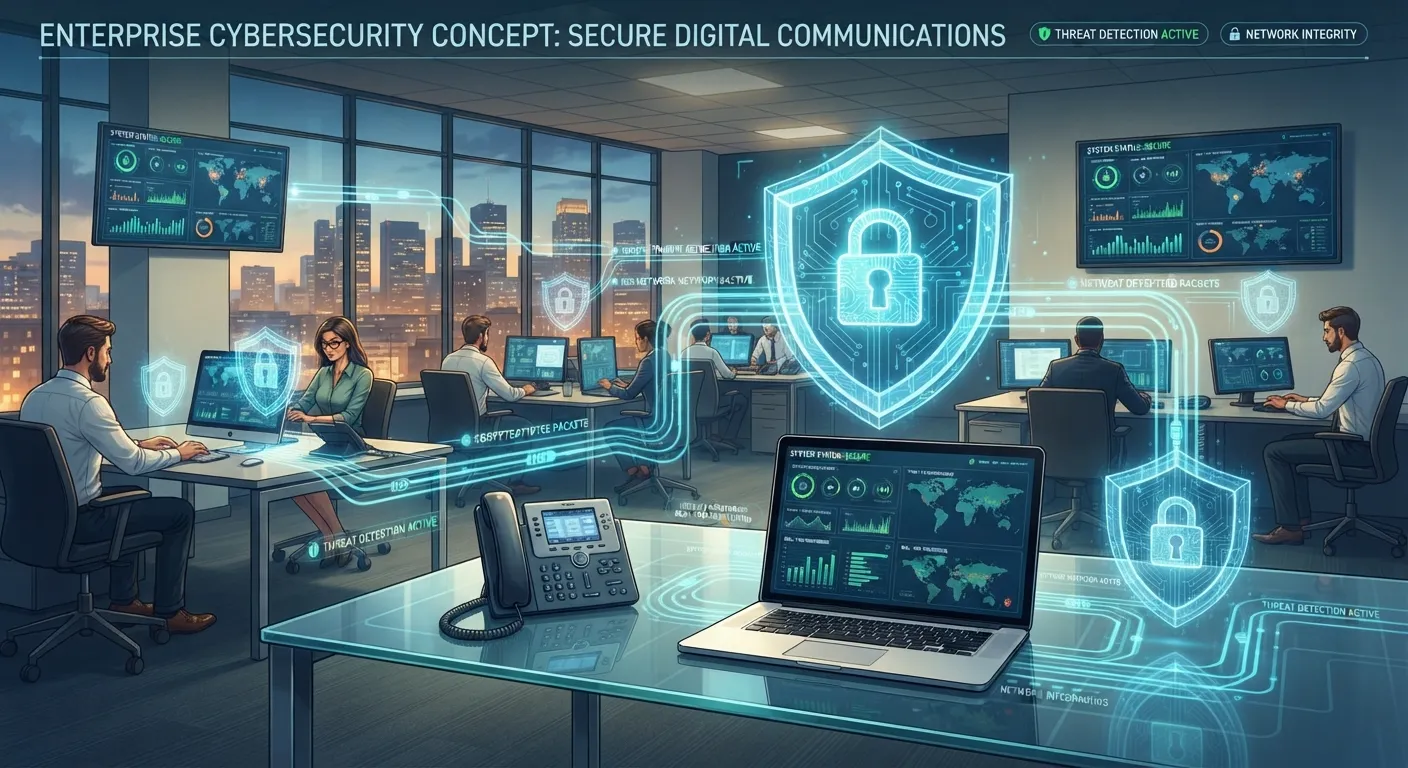
Moving your phone system onto SIP trunking brings real benefits—but like anything connected to the internet, it introduces a new set of security considerations that a traditional physical phone line generally didn’t face in the same way.
Toll fraud, unauthorized access, call interception, account compromise, and denial-of-service attacks are real risks with SIP. The good news is that these risks can be managed with the right combination of provider-level protections, secure configuration, monitoring, and internal controls.
When organizations modernize their communication infrastructure, understanding SIP trunking security becomes an important part of the migration process. A secure SIP deployment isn’t just about protecting phone calls. It’s also about protecting the business from unexpected telecom charges, service disruption, compromised customer information, and unauthorized use of business numbers.
Here’s what businesses should know about SIP security, the most common threats, and the practical steps that can reduce their exposure.
What Is VoIP / SIP Fraud?
One of the most common security problems associated with business VoIP systems is toll fraud.
Toll fraud occurs when an unauthorized person gains access to a business’s telephone system and uses it to make calls. Attackers may target international destinations, premium-rate services, or other expensive routes, potentially generating a large bill before the business realizes something is wrong.
For example, an attacker who obtains SIP credentials or compromises a poorly secured PBX could attempt to make hundreds or thousands of outbound calls through the company’s account.
The business may not immediately notice because the calls can look like legitimate outbound traffic from its own telephone system.
Other potential threats include:
-
Unauthorized access to SIP accounts
-
Call interception
-
SIP credential theft
-
PBX compromise
-
Denial-of-service attacks
-
Caller-ID abuse
-
Brute-force login attempts
-
Unauthorized international calling
-
Malware targeting PBX or telephony systems
These aren’t reasons to avoid SIP trunking. They’re reasons to treat a SIP trunk as part of the company’s broader IT infrastructure rather than as “just a phone line.” Understanding how modern digital platforms reshape communication ecosystems requires looking at how they replace legacy frameworks, as explored in our guide on how AI voice agents are replacing traditional call centers.
Why SIP Trunking Security Matters
A traditional telephone line was largely isolated from the company’s internet-connected systems. Modern SIP infrastructure is different.
Your PBX, firewall, SIP devices, cloud platforms, and network connections may all interact with the wider IP environment. That creates opportunities for better control and integration, but it also means the telephone system needs to be configured and protected appropriately.
A compromised phone system can create several types of damage.
Financial Damage
The most immediate risk is often fraudulent calling. An attacker doesn’t necessarily need to steal money directly. If they can use your account to make expensive calls, the resulting telecom charges can become the financial loss.
Operational Disruption
A security incident can also prevent legitimate customers from reaching your business. If a PBX is overloaded, compromised, or deliberately targeted, employees may be unable to make or receive calls. For businesses that depend heavily on telephone communication, even a relatively short outage can affect customer service and sales operations.
Reputational Damage
Customers expect business communication systems to be reliable and secure. If an incident affects customer information, calls, or availability, the consequences can extend beyond the immediate technical problem.
Before deploying enterprise voice automation or managing high-volume concurrency, it is critical to ensure your underlying connection is robust. Review our breakdown on 5 signs your business needs a cloud call center not just a phone line to evaluate whether your current setup supports modern security and scaling demands.
How Toll Fraud Happens
Understanding the attack path makes prevention easier. An attacker may first attempt to discover an exposed SIP endpoint, PBX interface, or set of credentials.
They could then attempt to:
-
Guess or steal authentication credentials.
-
Gain access to a SIP account or extension.
-
Use that account to place outbound calls.
-
Increase the volume or destination cost of those calls.
-
Continue until the activity is detected or the account is blocked.
Poorly configured systems can make this easier. For example, using default credentials, exposing management interfaces unnecessarily, allowing unrestricted international calling, or failing to monitor outbound traffic can increase the potential impact of a compromised account.
This is why SIP trunking security isn’t just the provider’s responsibility. The business operating the PBX and network also has an important role.
How SIP Trunking Providers Can Protect You
Security begins at the carrier level. A reputable SIP provider should have controls designed to detect unauthorized activity, protect signaling and media where supported, and limit the potential damage if an account is compromised.
Encryption With TLS and SRTP
Two technologies commonly associated with secure SIP communications are TLS and SRTP. TLS can be used to protect SIP signaling in transit. SRTP, or Secure Real-time Transport Protocol, can protect the actual voice media.
These technologies address different parts of the communication process. However, encryption availability and configuration vary by provider and network architecture. Businesses should therefore ask whether encryption is supported, whether it is enabled for their specific service, and which parts of the communication are protected. Encryption is particularly relevant when voice traffic travels across networks that the business doesn’t directly control.
Authentication
A SIP provider needs a way to determine whether a connection is authorized. Depending on the service architecture, authentication can involve credentials, IP-based restrictions, certificates, or other controls. Strong authentication makes it more difficult for an unauthorized system to use the trunk. Businesses should also protect SIP credentials just as carefully as they protect passwords for other important business systems.
IP Restrictions
Where appropriate, restricting SIP traffic to known IP addresses can significantly reduce exposure. If a business’s PBX only needs to communicate with specific trusted systems or provider endpoints, unnecessary access can be restricted through firewalls and network policies. The exact configuration depends on the provider and architecture, but the principle is straightforward: only allow the systems that actually need access.
Fraud Detection
Modern SIP providers can monitor calling patterns and identify activity that looks unusual. For example, a sudden increase in international calling, an unusual destination, or a major change in call volume could trigger an alert. Automated detection can be particularly useful because toll fraud can happen quickly. The earlier suspicious activity is detected, the easier it is to limit the financial impact.
Rate Limiting and Destination Controls
Businesses don’t necessarily need to call every destination in the world. A company operating entirely within Egypt, for example, may have little reason to allow unrestricted international calling from every extension. Destination restrictions and rate limits can therefore act as an additional layer of protection. If international calling is necessary, businesses can restrict it to the destinations and users that actually require it.
When you are evaluating network fundamentals, understanding the difference between a SIP trunk and VoIP helps clarify how carrier-grade routing and dedicated trunk architectures establish safer, more stable connections than consumer-grade VoIP setups.
What Your Business Should Do on Its End
Carrier-level security is only one part of the equation. The business operating the phone system needs to secure its own infrastructure as well.
1. Change Default Credentials
One of the simplest security improvements is also one of the most important. Never leave default passwords on PBXs, SIP devices, routers, or other systems. Use strong, unique credentials and change them when appropriate. Administrative credentials should also be separated from ordinary user credentials where the system supports it.
2. Keep Your PBX Updated
PBX software and other SIP-connected systems can contain vulnerabilities. Security updates may address bugs, authentication weaknesses, or other issues that attackers could exploit. Keep your PBX, operating system, firmware, and related software updated according to the vendor’s recommendations. This is particularly important for internet-connected systems.
3. Protect Management Interfaces
Your PBX’s administrative interface shouldn’t be unnecessarily exposed to the public internet. Where possible, management access should be restricted through appropriate firewall rules, VPNs, access-control policies, or other security mechanisms. The exact configuration depends on the platform, but the general rule is simple: a management interface should not be accessible to everyone just because the phone system needs to communicate externally.
4. Restrict International Calling
If your business doesn’t need international calling, consider disabling it. If it does, determine which employees, extensions, or departments actually need it. You can then create appropriate permissions instead of allowing every account to make unrestricted international calls. This can significantly reduce the potential impact of a compromised extension.
5. Monitor Call Logs
Call logs can provide an early warning that something isn’t right. Look for patterns such as unexpected international calls, large increases in call volume, calls outside normal business hours, unfamiliar destinations, repeated short-duration calls, calls from extensions that don’t normally make outbound calls, and sudden changes in average call costs. Automated monitoring is preferable where available, but regular manual reviews can still be useful for smaller businesses.
Set Spending Limits and Fraud Alerts
A spending limit can provide another layer of protection. Imagine that an attacker manages to compromise an account at 2 a.m. Without a spending limit or alert, fraudulent calling could continue for hours before anyone notices. With appropriate controls, the system might instead flag unusual activity, send an alert, restrict certain destinations, temporarily suspend outbound calling, or require manual approval. The exact options depend on the provider.
What About Call Interception?
Toll fraud gets a lot of attention because of its direct financial impact, but businesses should also consider the confidentiality of their voice communications. If voice traffic isn’t appropriately protected, there can be risks associated with interception on compromised or untrusted networks.
This is where encryption becomes relevant. TLS can help protect SIP signaling, while SRTP can protect voice media when supported and correctly configured. However, businesses shouldn’t assume that the phrase “encrypted” automatically means every part of a call is protected from end to end.
Ask the provider:
-
What is encrypted?
-
Where does encryption begin?
-
Where does it terminate?
-
Is voice media encrypted?
-
Is signaling encrypted?
-
Does encryption remain active across provider-to-provider connections?
The answers can vary depending on the architecture.
Can SIP Trunking Be Attacked Through the Internet?
Yes, like other internet-connected services, SIP infrastructure can be targeted by automated scanning and other attacks. Attackers may search for exposed services, attempt credential attacks, or try to overwhelm communication infrastructure.
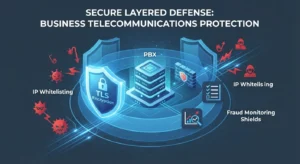
This is one reason why security should be implemented in layers. A typical secure architecture may include:
Additional controls can include IP restrictions, intrusion detection, authentication controls, network segmentation, monitoring, and provider-side filtering. The goal isn’t to rely on one security feature; it’s to make unauthorized access progressively more difficult while ensuring legitimate calls continue to work normally.
What Is a SIP ALG and Why Can It Cause Problems?
SIP ALG, or SIP Application Layer Gateway, is a feature found in some routers and firewalls. It’s intended to help network devices handle SIP traffic, but in some environments it can interfere with SIP signaling, audio, registration, or call setup.
This isn’t strictly a security vulnerability, but it can create connectivity and reliability problems that complicate troubleshooting. When deploying SIP trunking, your network team and SIP provider should verify the recommended firewall and NAT configuration for the specific service. Don’t assume that a router’s default SIP settings are automatically correct.
SIP Trunking Security for Remote Employees
Remote work adds another consideration. Employees may connect to business phone systems from different networks, locations, and devices. A secure architecture should ensure that remote access doesn’t unnecessarily expose the PBX or SIP infrastructure.
Depending on the platform, businesses may use secure softphone configurations, VPNs, strong authentication, device management, access restrictions, encrypted signaling and media, and centralized identity management. Remote users should also receive basic security guidance. An employee who shares SIP credentials or installs an unknown softphone application can unintentionally create an access point into the company’s communication system.
Questions to Ask Before Choosing a SIP Trunking Provider
Not every provider offers the same security controls. Before signing up, ask specific questions about SIP trunking security:
-
Are SIP signaling and voice media encrypted? Ask whether TLS and SRTP are supported and enabled for your particular service.
-
How do you detect toll fraud? Find out whether the provider monitors call patterns and how quickly suspicious activity can be detected.
-
Can I restrict international destinations? Destination controls can help prevent unauthorized high-cost calls.
-
Can I set spending limits? Ask whether the account supports spending caps, automatic blocking, or configurable thresholds.
-
What happens when suspicious activity is detected? Ask whether the provider sends alerts, blocks calls, suspends the trunk, or contacts the customer.
-
How is SIP traffic authenticated? Understand whether the service uses credentials, IP authentication, certificates, or another mechanism.
-
What security responsibilities remain with the customer? A good provider should explain which protections it handles and which ones your IT team needs to configure.
Security Is a Shared Responsibility
One of the most important things to understand about SIP trunking security is that no provider can secure the entire system on its own. The provider controls its carrier infrastructure. Your business controls its PBX, network, devices, credentials, users, and internal security policies. Both sides matter.
A provider can have strong fraud monitoring, but a business can still be compromised through a weak PBX password. Likewise, a business can have an extremely well-secured network but still suffer problems if its telecom provider doesn’t provide appropriate monitoring or fraud controls. The strongest approach combines both.
A Practical SIP Security Checklist
Before putting a SIP trunk into production, businesses should ensure the following items are addressed:
-
Default PBX and device credentials have been changed.
-
Strong passwords are being used.
-
PBX and SIP-connected software are up to date.
-
Administrative interfaces aren’t unnecessarily exposed.
-
Firewall rules have been reviewed.
-
SIP traffic is restricted where appropriate.
-
International calling is limited where possible.
-
High-risk destinations are controlled.
-
Call logs are monitored.
-
Fraud alerts are enabled.
-
Spending limits are configured where available.
-
Encryption options have been reviewed.
-
Remote access has appropriate security controls.
-
Employees understand basic credential-security requirements.
-
The provider has a documented fraud-response process.
-
There is a plan for what happens if the SIP service becomes unavailable.
Not every item will apply identically to every architecture, but working through the list can expose weaknesses before they become incidents.
Is SIP Trunking Less Secure Than Traditional Phone Lines?
It’s not accurate to say that SIP trunking is inherently insecure simply because it uses IP networks. The security profile depends heavily on how the system is designed, configured, monitored, and maintained.
Traditional telephone infrastructure also has security and fraud considerations. SIP simply introduces a different set of risks because the communication system is part of an IP-based environment. The advantage of modern IP telephony is that it can also provide security controls that are difficult or impossible to implement with older infrastructure, including centralized monitoring, access controls, encryption, automated fraud detection, configurable restrictions, and detailed usage analytics. The important thing is to actually configure and use those controls.
The Bottom Line
SIP trunking security isn’t something businesses should think about only after a suspicious phone bill arrives. Toll fraud, unauthorized access, call interception, and service disruption are legitimate risks, but they can be managed through layered security.
The foundation is straightforward: secure the PBX, protect SIP credentials, restrict unnecessary access, control international calling, monitor call activity, enable fraud alerts and spending controls, use encryption where appropriate, and choose a provider with strong carrier-level security.
The businesses most likely to run into trouble are generally those that treat their SIP trunk like an ordinary phone line rather than recognizing that it is part of their internet-connected infrastructure. A secure deployment combines provider-level protections with good internal security practices.
SIP Egypt provides carrier-grade SIP trunking with security controls designed for business communications, including fraud monitoring and configurable calling controls. If you’re migrating from legacy telephone infrastructure, our team can help review the telephony architecture and security requirements before you go live.