

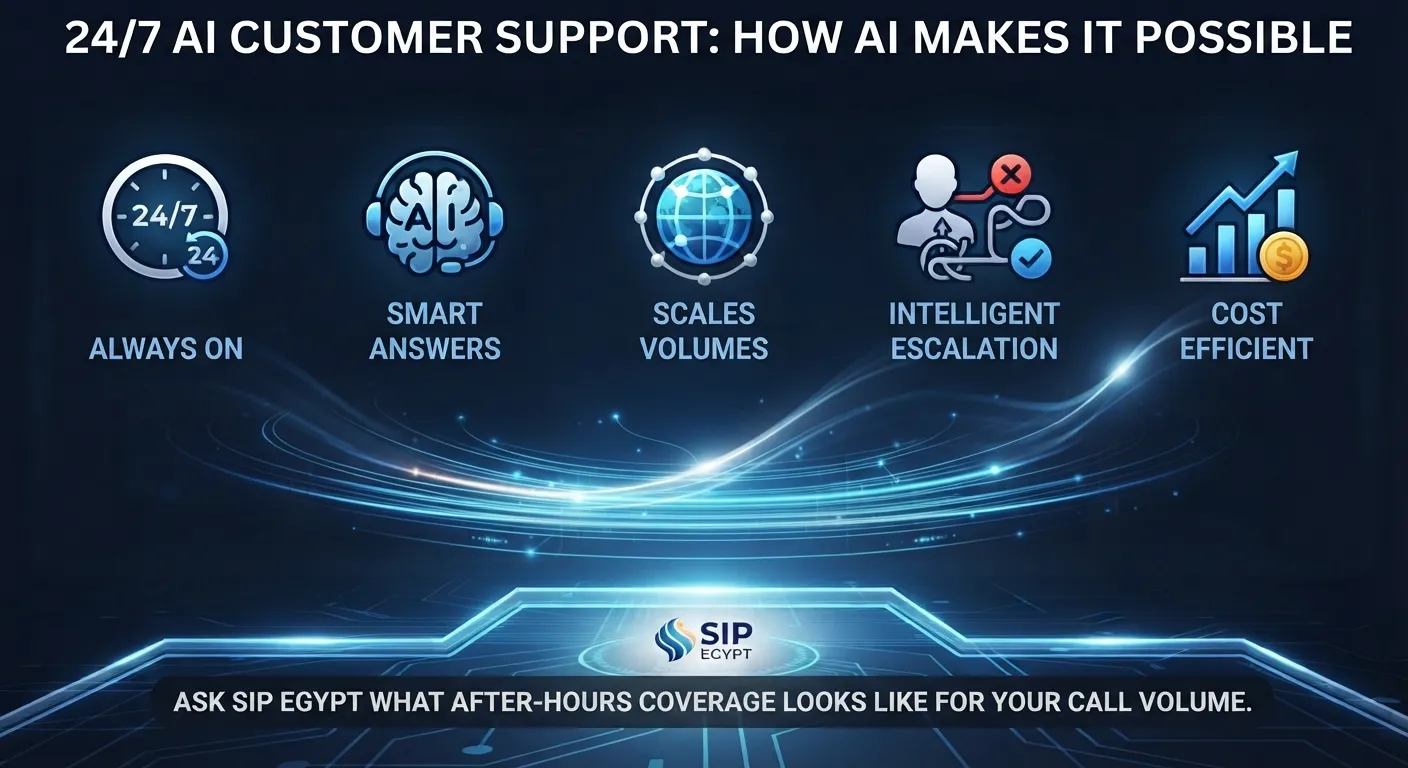
Customers don’t stop needing help at 6pm, but most businesses stop being able to provide it right around then. Hiring a night shift team to cover the gap is expensive, hard to staff consistently, and often barely justified by the call volume it needs to handle. AI voice agents solve the same coverage problem without the staffing overhead.
When scaling enterprise communications to meet round-the-clock expectations, integrating reliable 24/7 AI customer support allows businesses to capture leads and resolve inquiries long after standard office doors have closed.
Why After-Hours Coverage Matters More Than It Used To
As more customers shop, book, and reach out outside traditional business hours—driven by everything from e-commerce to shift work to simply being busy during the day—the expectation of being able to get help whenever they think of it has grown accordingly. A business that only answers 9-to-5 is increasingly the exception rather than the norm, and every after-hours call that goes unanswered is a chance for a customer to look elsewhere.
The Traditional Options, and Why They Fall Short
Standard approaches to managing off-peak hours historically suffer from heavy limitations:
-
Hiring a night shift team: expensive, hard to staff reliably, and often overkill for call volume that’s real but modest after hours.
-
Outsourcing to a generic answering service: cheaper than a dedicated team, but usually limited to message-taking rather than actually resolving anything.
-
Voicemail: costs nothing but resolves nothing — most callers who hit voicemail for a real question simply don’t call back.
How AI Voice Agents Fill the Gap
An AI voice agent doesn’t need shifts, breaks, or overtime pay — it can answer calls at 2am with the same quality as calls at 2pm. For after-hours coverage specifically, that means common questions get answered immediately, appointments get booked and confirmed, and leads get captured with full context, all without a human on the line.
What It Can Realistically Handle Overnight
A properly configured assistant can manage a wide array of after-hours tasks smoothly:
-
Answering frequently asked questions — hours, pricing tiers, service availability, order status.
-
Booking and confirming appointments for the next business day.
-
Capturing detailed lead information so your sales team has everything they need first thing in the morning.
-
Handling simple support requests that don’t require account-specific human judgment.
What Still Needs a Human
Genuinely complex or sensitive issues — an angry customer, an ambiguous account problem, anything requiring real judgment — should still route to a human, just during business hours if there’s no overnight team. A well-configured AI voice agent recognizes these cases and either flags them for priority follow-up or offers a callback, rather than trying to force a resolution it isn’t equipped to handle overnight.
The Cost Comparison, Practically Speaking
Staffing even a lean night shift means paying for hours where call volume is often unpredictable and inconsistent — some nights busy, most nights quiet, with the cost fixed either way. An AI voice agent scales to whatever the actual call volume is, without the fixed cost of shift coverage, which is why it tends to make the most sense specifically for the after-hours window rather than as a full daytime replacement for your team.
Getting Started
The simplest way to add this is to configure your AI voice agent to handle calls only outside your current business hours to start, so your daytime operation doesn’t change at all. Once you can see what after-hours callers are actually asking for, you can expand its role from there.
SIP Egypt’s AI voice agents can pick up exactly where your team’s hours end — answering questions, booking appointments, and capturing leads overnight. Ask us what after-hours coverage would look like for your call volume.