

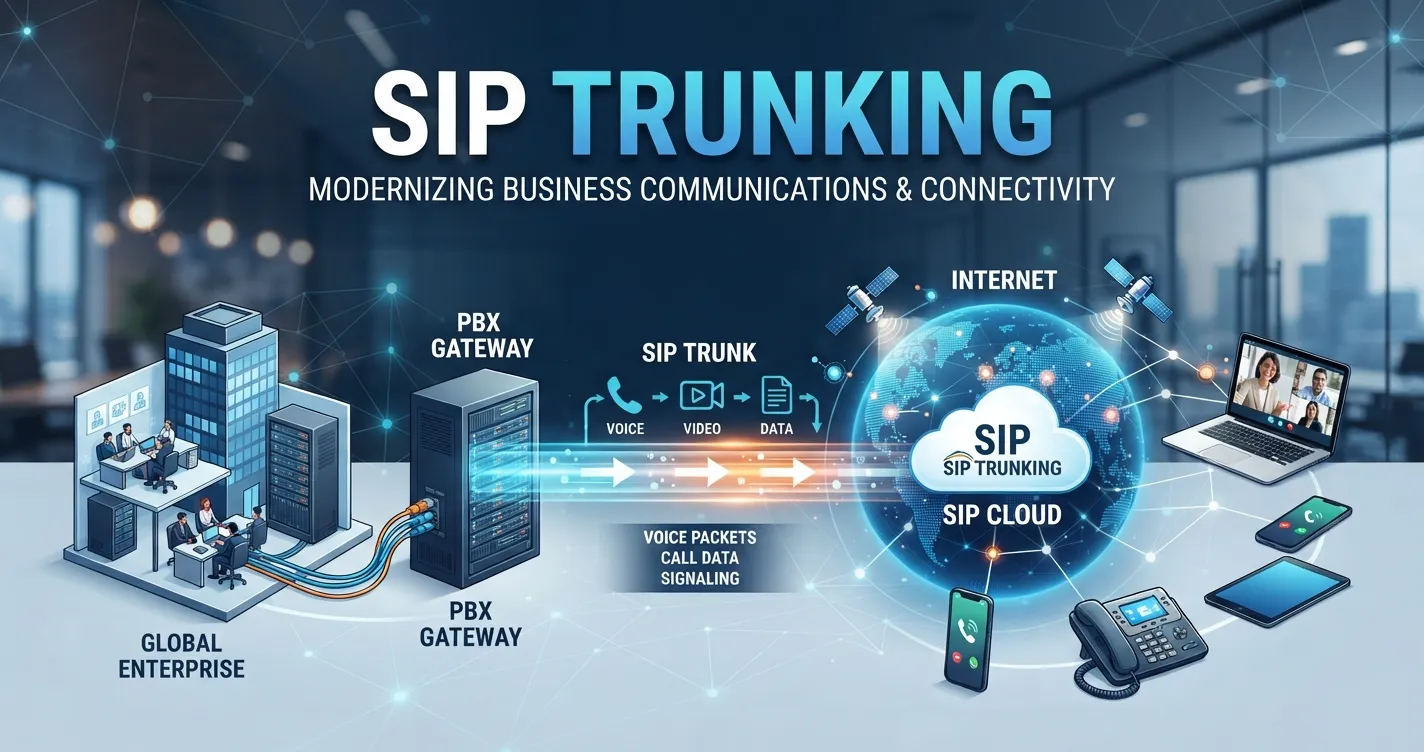
If your business is still paying for a fixed number of physical phone lines, you’re probably paying for capacity you don’t use and running into limits the moment you actually need it. SIP trunking solves both problems, and it’s become the standard way businesses in Egypt connect their phone systems to the outside world. Here’s what it actually is, how it works, and what to look for before you switch.
What Is SIP Trunking, Exactly?
SIP trunking (Session Initiation Protocol trunking) is a way of delivering voice calls over the internet instead of copper phone lines. Instead of a physical cable running into your building for every simultaneous call you want to handle, a SIP trunk is a virtual connection that carries voice traffic as data — the same way your internet connection carries everything else.
In practice, a SIP trunk connects your existing phone system (a PBX, a softphone app, or a cloud call center platform) to the public telephone network through your SIP provider. You get one flexible connection that can carry as many simultaneous calls as you’ve provisioned it for, rather than a fixed number of physical lines.
How Does SIP Trunking Work?
When someone calls your business number, the call is routed over the internet to your SIP provider’s network, converted if needed, and delivered to your phone system as a SIP session. Outbound calls work the same way in reverse. Because it’s all happening over IP, the same trunk can carry voice, and in more advanced setups, video and messaging too.
The key technical difference from a traditional line is capacity. A physical PSTN line can only carry one call at a time. A SIP trunk is provisioned for a number of “channels” — each channel supports one simultaneous call — and you can typically scale that number up or down as your call volume changes, without an engineer visiting your office.
SIP Trunking vs. Traditional Phone Lines
- Cost: SIP trunking generally costs less per channel than physical lines, and you’re not paying for unused capacity.
- Scalability: Adding capacity is a configuration change, not a hardware installation.
- Flexibility: Numbers and channels aren’t tied to a physical location — useful for remote teams or multiple branches.
- Redundancy: A good SIP provider routes around outages automatically; a single physical line has no such fallback.
- Features: SIP trunking integrates directly with modern call center software, CRMs, and AI voice tools — something legacy lines can’t do natively.
Benefits of SIP Trunking for Egyptian Businesses
For businesses operating in Egypt, SIP trunking solves a few very specific problems. First, it removes the wait time and paperwork typically associated with provisioning new physical lines through a legacy carrier. Second, it lets you assign local Cairo numbers or nationwide numbers without needing a physical presence in every city you want a local number for. Third, because SIP trunks run over your existing internet connection, businesses with multiple branches can centralize their phone system instead of managing separate setups at each location.
There’s also a resilience argument: with carrier-grade SIP infrastructure and redundant routing, your business phone line isn’t dependent on a single point of failure the way a traditional line often is.
What to Look for in a SIP Trunking Provider
- Uptime SLA — ask what percentage uptime is guaranteed and what happens when it’s missed.
- Local number coverage — can they provision Cairo and nationwide DIDs, and how quickly?
- Transparent pricing — per-channel and per-minute rates should be clear upfront, not buried in a quote.
- Compatibility — confirm it works with your existing PBX, softphone, or call center software before switching.
- Support — when a call quality issue comes up, is there a local team you can actually reach?
Common SIP Trunking Myths, Debunked
“SIP trunking sounds unreliable because it’s over the internet” — in practice, a properly provisioned SIP trunk with redundant routing is often more reliable than a single physical line, which has no fallback if that one line goes down.
“It’s only for large call centers” — SIP trunking scales down just as well as it scales up. A small business with two or three lines’ worth of call volume benefits from the same flexibility and cost savings as a 50-agent call center.
“Switching means replacing all our phone hardware” — most SIP providers support existing PBX systems and many IP phones. In most cases, switching is a configuration change, not a hardware overhaul.
Is SIP Trunking Right for Your Business?
If you’re paying for phone lines you don’t fully use, waiting weeks to get a new number provisioned, or trying to connect your phone system to modern tools like a CRM or an AI voice agent, SIP trunking is very likely the right move. The clearest way to know is to look at your current call volume, how often it spikes, and how much flexibility your current setup gives you to handle that — if the answer is “not much,” it’s worth a conversation.
SIP Egypt provides carrier-grade SIP trunking with Cairo and nationwide DID numbers, provisioned in minutes rather than weeks. If you’re evaluating a switch, our engineering team can map your current call volume to a plan that fits — no obligation.